
Most homeowners have heard of MCBs and RCDs. Some have heard of RCBOs. Very few have heard of AFDDs — and yet arc fault detection is the next step in electrical safety, already legally required in certain types of building in the UK, and strongly recommended in others.
This guide explains what an AFDD is, how arc faults differ from the electrical faults that MCBs and RCBOs catch, when UK law requires arc fault protection, and why Power Team Electrics recommends AFDDs without hesitation for thatched and timber-frame properties across the Home Counties.
What Is an Arc Fault?
An arc fault is an abnormal electrical discharge — sparking — that occurs at a point of damage, degradation, or loose connection in a circuit. Unlike an overload or short circuit, arc faults produce a sustained, high-energy spark at low current levels, well below the trip threshold of a conventional MCB or RCBO.
Arc faults can persist undetected for minutes, generating intense localised heat. Within a wall cavity, ceiling void, or beneath floorboards, that heat is typically sufficient to ignite surrounding materials. By the time fire becomes apparent to occupants, the fire may already have spread significantly through the structure.
Common causes include:
- Physical damage to wiring during building work
- Cable pinched beneath floorboards or at skirting fixings
- Degraded or brittle insulation on older wiring
- Loose terminal connections at back boxes
- Damaged flexible cables on appliances near sockets
What Is an AFDD?
An AFDD (Arc Fault Detection Device) continuously monitors the electrical waveform of a circuit. Arc faults produce a characteristic distortion signature that is detectable in real time. When the AFDD recognises that signature, it disconnects the circuit immediately — before the arc can generate enough heat to ignite surrounding materials.
A standard MCB or RCBO has no ability to detect arc faults. They trip on current magnitude — a short circuit or overload. Arc faults do not, by definition, produce the current levels needed to trigger those devices. An AFDD monitors the shape of the waveform itself, not just its magnitude. This is a fundamentally different type of protection.
In practice, AFDDs are combined with RCBOs to create an AFDD-RCBO: a single device providing overload protection, short circuit protection, earth fault protection, and arc fault detection. A full AFDD consumer unit replaces every standard RCBO with an AFDD-RCBO, giving complete protection on every circuit.
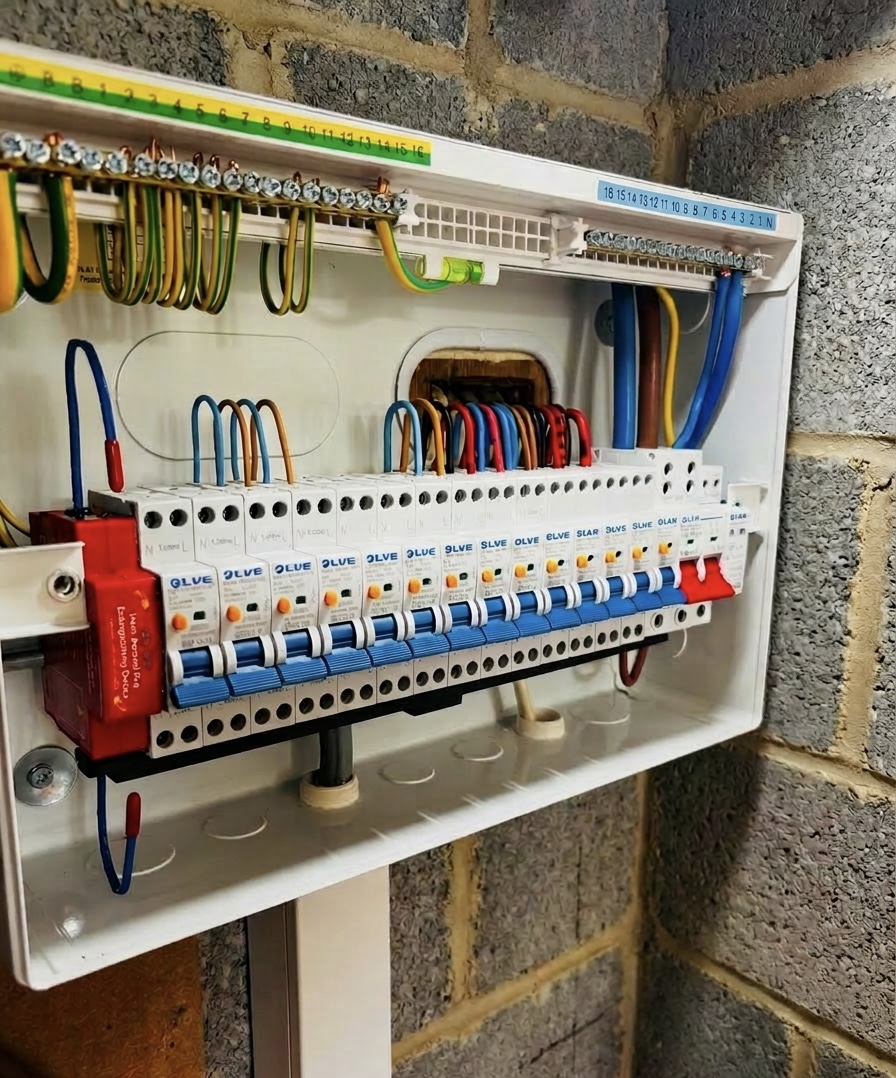
Protection Hierarchy: MCB, RCBO, and AFDD-RCBO Compared
To understand where AFDDs sit, it helps to see how the three main devices compare across the four categories of electrical fault.
| Device | Overload | Short Circuit | Earth Fault | Arc Fault |
|---|---|---|---|---|
| MCB | Yes | Yes | No | No |
| RCBO | Yes | Yes | Yes | No |
| AFDD-RCBO | Yes | Yes | Yes | Yes |
An RCBO is the current recommended standard for fuse board upgrades — it is a significant improvement over an MCB. An AFDD-RCBO takes that further by adding the one category of protection that neither MCBs nor RCBOs can provide. For properties where a fire starting inside a wall cavity could have severe consequences, that additional layer matters considerably.
When Is an AFDD Legally Required in the UK?
Regulation 421.1.7 of BS 7671:2018 (18th Edition) Amendment 2 requires AFDDs on socket outlet circuits in the following types of building:
- Purpose-built blocks of flats
- Houses in Multiple Occupation (HMOs)
- Care homes
- Student accommodation
- Similar high-risk residential buildings
For these building types, AFDD protection is not optional — it is a legal requirement for new installations and significant upgrades.
For standard single-occupancy homes, AFDDs are not currently a legal requirement. However, the legal picture only tells half the story. The absence of a legal mandate for owner-occupied homes does not mean AFDDs are unnecessary — it means the risk assessment is left to the homeowner. And for certain property types, that risk is not trivial.
At Power Team Electrics, we install AFDDs on all circuits in buildings where they are required — not just socket outlet circuits. This exceeds the minimum requirement and reflects our view that arc faults are not selective about which circuit they originate from.
Thatched Cottages, Timber-Frame Houses, and Combustible Buildings
Power Team Electrics strongly recommends AFDD protection on all circuits in any property where wiring runs near or through combustible structural materials. This includes:
- Thatched cottages
- Timber-frame houses
- Oak-frame properties
- Log cabins and converted timber outbuildings
- Any building where wiring runs near or through combustible structural materials
In a standard masonry property, an arc fault that generates localised charring gives the fire service time to respond. The damage may be serious, but it is typically contained.
In a thatched property, the same fault — an arc inside a wall cavity running through or near the thatch — can spread across the entire roof within minutes. Even a fast fire service response may arrive to find the structure fully involved. Total loss of the building is a realistic outcome. That is not a hypothetical scenario; it is a documented pattern in UK fire investigation records.
The Home Counties have more thatched properties than almost any other region in England — rural Surrey, Kent, Berkshire, Hertfordshire, and Essex all have significant concentrations. If you own a thatched cottage or timber-frame property in any of our coverage areas, we would always recommend an AFDD board when upgrading your consumer unit.
There is also an insurance implication. Installing AFDDs is a demonstrable risk-reduction step. It is worth discussing your installation with your specialist thatched property insurer — some may offer preferential terms for properties with arc fault detection fitted.
The Cost of an AFDD Consumer Unit
AFDD-RCBO devices are significantly more expensive than standard RCBOs. Approximately:
- An AFDD-RCBO costs around 7 times more than a standard RCBO
- An AFDD-RCBO costs around 50 times more than a basic MCB
A full AFDD consumer unit therefore costs more than a standard RCBO board. This is not a small difference, and Power Team Electrics will always be transparent about it in our quotations.
The relevant comparison is not AFDD board versus standard board. It is the cost of the AFDD board versus the cost of a total structural loss. For a thatched cottage with a rebuild value of £500,000 or more, the additional premium for arc fault protection is modest. For a standard masonry property, the calculus is less compelling — which is why we present this as a recommendation for specific property types rather than a universal mandate.
Power Team Electrics provides transparent, itemised pricing for all consumer unit upgrades. Where AFDD protection is relevant to your property, we will quote it clearly alongside the standard RCBO option.
What an AFDD Upgrade Involves
- Assessment and specification — your electrician assesses whether your property type and installation make AFDDs appropriate or required.
- Isolation and removal of the existing consumer unit.
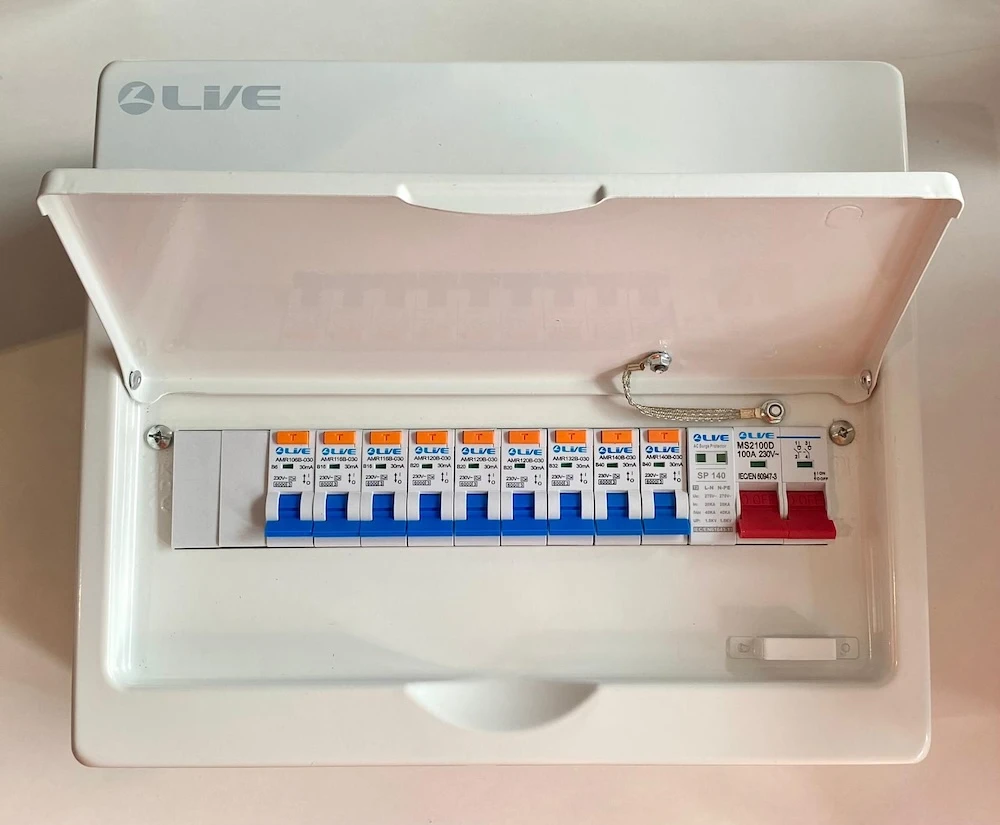
- Installation of a new 18th Edition compliant metal consumer unit with AFDD-RCBO devices on every circuit, plus an SPD as standard.
- Testing to full BS 7671:2018 requirements.
- Certification — an Electrical Installation Certificate issued under Part P, with a full test report left with you on the day.
All AFDD consumer unit upgrades are Part P notifiable works, carried out and certified by a registered competent person. The Part P certificate and EIC are the formal record of compliance, accepted by insurers, mortgage lenders, and property solicitors.
Coverage
Power Team Electrics carries out AFDD consumer unit upgrades and fuse board replacements across the Home Counties, including Surrey (Guildford), Kent (Maidstone), Essex (Chelmsford), Hertfordshire (St Albans), Berkshire (Reading), Buckinghamshire (Milton Keynes), and Sussex (Brighton).
All works fully certified. 18th Edition compliant. Visit www.powerteamelectrics.co.uk to get a quote or book a survey.