
The RCD is one of the most important electrical safety inventions of the twentieth century. It is faster than any human reaction, more sensitive than any conventional circuit breaker, and capable of preventing the type of electrocution that MCBs and fuses simply cannot stop. If your home does not have full RCD protection on every circuit, it is not protected to the standard required by current wiring regulations.
This guide explains exactly what an RCD does, how it detects faults that other devices miss, what happened when the regulations changed, and why an RCBO board — with individual protection on every circuit — is now the recommended standard for UK homes.
What Is an RCD?
An RCD (Residual Current Device) is a safety device that continuously monitors the balance of current flowing out on the live conductor and returning on the neutral. In a healthy circuit, these values are equal. If they are not — if current is escaping into the earth, into a person, or into water — there is a residual current. The RCD detects this imbalance and trips the circuit in 30 to 40 milliseconds.
To put that in context: 30 milliseconds is roughly one fifteenth of a second. Research shows that cardiac fibrillation can occur if alternating current at 30mA flows through the body for more than 100 milliseconds. An RCD trips before that threshold is reached. This is why the standard trip threshold is set at 30mA — the maximum level of leakage that should ever be permitted before the circuit is isolated.
At the heart of every RCD is a toroid — a magnetic coil through which both the live and neutral conductors pass. In a healthy circuit, the magnetic fields produced by the outgoing and returning currents cancel each other exactly. When a fault occurs and current takes an unintended path to earth, the fields no longer cancel. The monitoring circuit detects the resulting imbalance and the device trips immediately.
What RCDs Cannot Do
Understanding what an RCD does not protect against is equally important. An RCD provides earth fault protection. It does not provide overload protection — that is the job of an MCB or RCBO. It does not detect arc faults at low current. And it only protects against faults that involve a path to earth: a live-to-neutral short circuit at high current is not an earth leakage event, and it is the MCB's overcurrent protection that handles it.
This is why a combined RCBO (Residual Current Breaker with Overcurrent protection) is now the recommended standard. An RCBO combines the earth fault protection of an RCD with the overload and short circuit protection of an MCB in a single device, providing complete protection on every individual circuit.
RCDs Also Prevent Electrical Fires
The fire prevention role of RCDs is less commonly understood than the electrocution protection role, but it is equally significant.
A neutral-to-earth fault — wiring deteriorating inside a wall cavity, a damaged cable drawing current through the earth path — does not necessarily produce a large current. A conventional MCB will not trip on a small leakage current. Left undetected, the fault generates sustained heat inside the wall. Over time, this can reach ignition temperature. The result is a fire starting silently inside the structure, with no external warning before it takes hold.
An RCD detects that leakage current and trips before the heat can build to a dangerous level. This is a category of protection that MCBs alone simply cannot provide.
Regulatory History: How RCD Requirements Have Evolved
The regulatory history of RCDs in the UK documents the industry's increasing understanding of electrical risk in domestic properties.
1991 — 16th Edition
The 16th Edition of the IET Wiring Regulations introduced the first requirement for RCDs — but only on certain high-risk circuits: outdoor socket outlets, electric shower circuits, and locations adjacent to water. The majority of circuits in a domestic property had no RCD protection at all.
2008 — 17th Edition
The 17th Edition represented a step change in approach. RCD protection was extended to cover almost all circuits in domestic installations — most socket outlet circuits, most lighting circuits, and any circuit accessible to an occupant. Split-load consumer units became the standard, with two shared RCDs protecting different groups of circuits across the property.
Today — 18th Edition
The 18th Edition (BS 7671:2018) recommends individual RCBO protection on every circuit. An RCBO on each circuit provides the same earth fault protection as an RCD, combined with independent overload and short circuit protection. It also eliminates the nuisance tripping problems associated with shared-RCD split-load boards.
Why RCBO Boards Are Recommended Over Split-Load Boards
If your home has a split-load consumer unit — the type with two shared RCDs protecting groups of circuits — you may have experienced nuisance tripping: an RCD trips for no obvious reason, cutting power to half the house.
The cause is modern electronics. Computers, phone chargers, LED drivers, smart home devices, and televisions all use switch-mode power supplies that produce small DC leakage currents. Each device contributes a tiny amount — individually well below the 30mA trip threshold, but cumulative across all devices sharing the same RCD. When the combined leakage approaches 30mA, the RCD trips, even though no single device has a genuine fault.
This is nuisance tripping, and it is a fundamental limitation of shared-RCD boards in homes with modern electrical loads. It is not a fault with any specific appliance — it is an architectural limitation of the board itself.
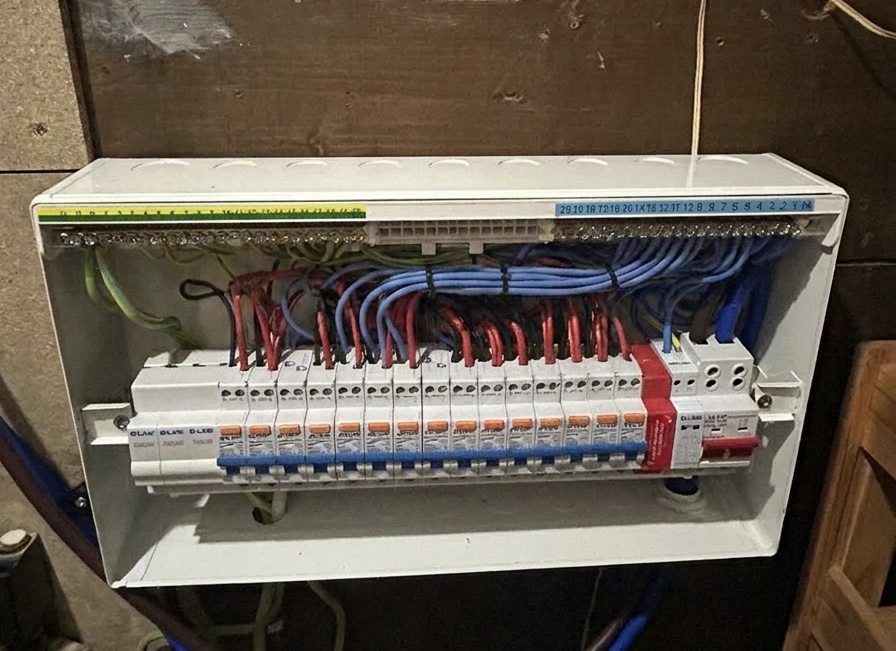
An RCBO consumer unit resolves this at the root. Each circuit has its own RCBO, which monitors only its own circuit. Cumulative leakage from every other device in the house does not build up against a shared threshold. A fault on one circuit trips only that circuit, and fault location is immediately obvious from the labelled breaker that has tripped.
Power Team Electrics recommends RCBO boards as the current best standard for every consumer unit upgrade we carry out.
Do You Need an RCD Upgrade?
Whether you need an upgrade depends on what type of consumer unit your property currently has. Here is a guide to the most common situations:
| Consumer Unit Type | RCD Coverage | Recommendation |
|---|---|---|
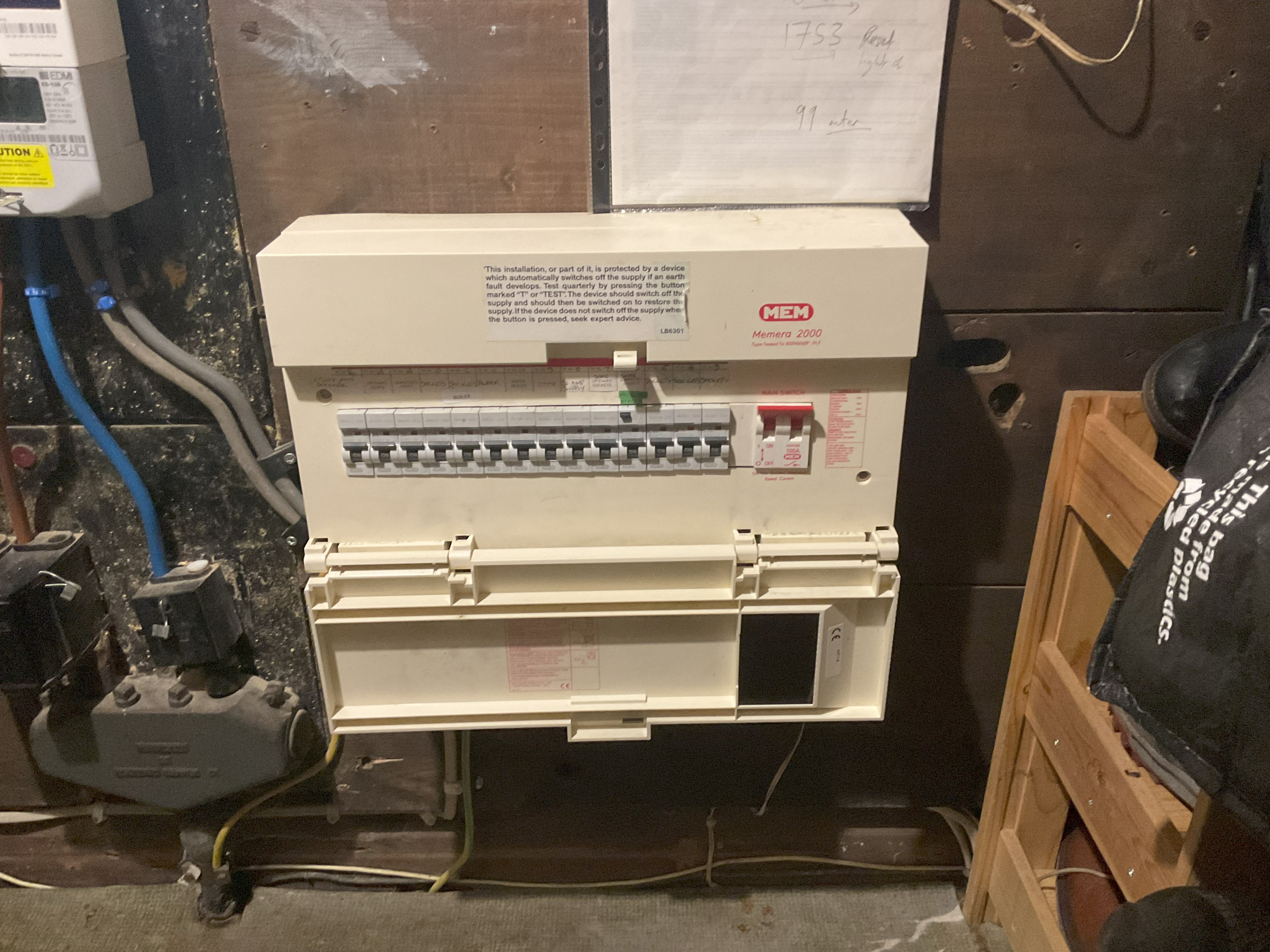
| Rewireable fuse board (Wylex-style) | None | Upgrade urgently |
| Older MCB board with no RCDs | None | Upgrade recommended |
| Split-load board (one or two shared RCDs) | Partial — groups of circuits | Consider upgrade, especially with nuisance tripping |
| Metal RCBO consumer unit | Full — individual per circuit | Current recommended standard |
If your board has no devices with a TEST button — no RCDs at all — you have no earth fault protection on any circuit. This should be addressed as a priority. If your board has shared RCDs and you are experiencing nuisance tripping, upgrading to an RCBO board will resolve it and provide full per-circuit protection at the same time.
What an RCBO Consumer Unit Upgrade Involves
A consumer unit upgrade at Power Team Electrics includes:
- Full isolation of the existing board and safe removal of the old unit
- Installation of a new 18th Edition compliant metal RCBO consumer unit — one RCBO per circuit
- A Surge Protection Device (SPD) fitted as standard on every board we install
- Full testing to BS 7671:2018 requirements
- An Electrical Installation Certificate issued under Part P, provided on the day
All consumer unit upgrades are Part P notifiable works, carried out and certified by a registered competent person. The certificate is the formal record of compliance, accepted by insurers, mortgage lenders, and property solicitors.
Coverage
Power Team Electrics carries out consumer unit upgrades and RCD protection assessments across the Home Counties: Surrey (Guildford), Kent (Maidstone), Essex (Chelmsford), Hertfordshire (St Albans), Berkshire (Reading), Buckinghamshire (Milton Keynes), and Sussex (Brighton).
All works fully certified. 18th Edition compliant. Visit www.powerteamelectrics.co.uk to get a quote or book a survey.