
Open your fuse board and you will see a row of switches. Some are narrow. Some are wider. One or two may have a small button labelled TEST. These are not all the same device — they are completely different types of protective equipment, each designed to respond to a different type of fault. Understanding what each one does is the first step to knowing whether your home is properly protected.
MCB — Miniature Circuit Breaker
An MCB (Miniature Circuit Breaker) is the narrow toggle switch you will see labelled by circuit — Lights, Sockets, Cooker, and so on. It is the direct replacement for the old fuse wire that used to perform the same job.
An MCB protects against two specific types of electrical fault:
- Overload — too much current drawn continuously from a circuit. If you run too many high-draw appliances on a single circuit, the cable begins to overheat. The MCB detects the sustained overcurrent and trips before the cable can reach a dangerous temperature.
- Short circuit — a sudden, massive fault current caused when the live and neutral conductors come into direct contact. An MCB trips almost instantaneously in response to this, protecting both the wiring and any connected equipment.
Unlike old fuse wire, an MCB can be reset by hand once the fault has been identified and cleared. This is the practical reason fuse wire was replaced — no more trips to the garage for fuse wire in the dark.
What an MCB does not protect against: earth faults, electrocution, neutral faults, and arc faults. These are entirely different categories of danger that an MCB has no mechanism to detect. If your fuse board has MCBs but no RCDs, you have overload and short circuit protection — but no protection against electrocution.
RCD — Residual Current Device
An RCD (Residual Current Device) is the wider switch with a TEST button. It serves a completely different purpose from an MCB — and it is the device that protects against the type of fault most likely to kill someone.
An RCD continuously monitors the balance between the current flowing out on the live conductor and the current returning on the neutral. In a healthy circuit, these values are equal. If current is escaping — leaking to earth, flowing through water, or passing through a person — the balance is broken. The RCD detects this imbalance and trips the circuit in approximately 30 milliseconds at a threshold of 30mA.
That response speed is not arbitrary. Research shows that cardiac fibrillation can occur if alternating current at 30mA flows through the body for more than about 100 milliseconds. An RCD at the 30mA threshold trips in well under that window — fast enough to prevent a fatal electric shock in the great majority of fault scenarios.
An RCD also provides protection against neutral faults — situations where the neutral conductor deteriorates and begins carrying current through unintended paths inside wall cavities. A neutral fault does not necessarily produce enough current to trip an MCB, but the resulting imbalance is detectable by an RCD. This category of fault can cause sustained heating inside walls over weeks or months, with no external sign until a fire develops.
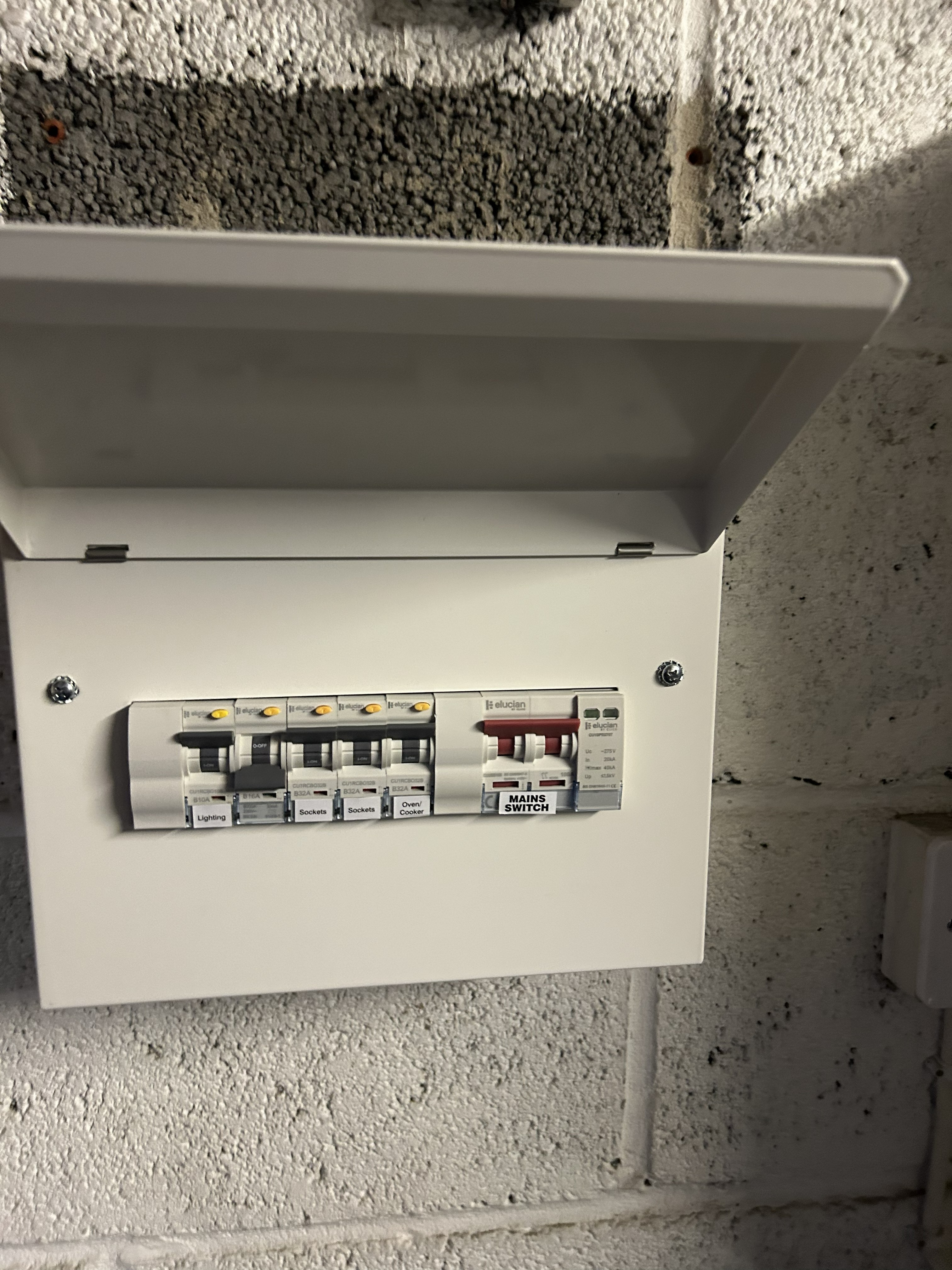
RCBO — Residual Current Breaker with Overcurrent Protection
An RCBO (Residual Current Breaker with Overcurrent protection) combines the functions of both an MCB and an RCD in a single device. It provides:
- Overload protection — the MCB function
- Short circuit protection — the MCB function
- Earth fault and electrocution protection — the RCD function
Critically, each RCBO is dedicated to one individual circuit. In an RCBO consumer unit, the lighting circuit has its own RCBO, each ring main has its own RCBO, and every other circuit has its own RCBO. A fault on one circuit trips only that device. The rest of the house remains live.
This is the current recommended standard under BS 7671:2018 (18th Edition) — the IET Wiring Regulations that govern all new electrical work in the UK. An RCBO board provides the same protection that a combination of MCBs and shared RCDs provides, but without the gaps and limitations of older split-load arrangements.
RCD vs RCBO — The Key Difference
The distinction is straightforward but important. An RCD on a split-load consumer unit is a shared device — it monitors a group of circuits simultaneously. When the RCD trips, it takes down every circuit it covers.
An RCBO is individual — it monitors only its own circuit. When it trips, only that circuit loses power.
This has two practical implications:
- No nuisance tripping. In a split-load board, leakage from every device on every circuit behind a shared RCD accumulates against a single 30mA threshold. Modern electronics — LED drivers, phone chargers, computers, smart home devices — each produce small amounts of earth leakage as part of normal operation. Cumulatively, they can push a shared RCD over its trip threshold even when nothing is actually faulty. An RCBO board eliminates this entirely: each circuit's leakage is only ever measured against its own individual threshold.
- Fault location is immediate. When an RCBO consumer unit trips, the tripped device tells you exactly which circuit has the problem. In a split-load board, a tripped RCD takes down half the house and gives you no information about which circuit is at fault.
The Test Button
Both RCDs and RCBOs have a TEST button, labelled T or TEST on the face of the device. Pressing it simulates a fault condition and should cause the device to trip immediately.
Test your RCDs and RCBOs quarterly. If a device does not trip when the TEST button is pressed, it may be faulty — it may not trip under actual fault conditions either. Have it investigated by a qualified electrician. An RCD that fails silently is not protecting the circuits it covers.
If your fuse board has no devices with a TEST button — only narrow toggle switches — it has no residual current protection at all. This is a significant safety concern.
Protection Comparison: MCB, RCD, RCBO, and AFDD-RCBO
| Device | Overload | Short Circuit | Earth Fault / Electrocution | Arc Fault |
|---|---|---|---|---|
| MCB | Yes | Yes | No | No |
| RCD | No | No | Yes | No |
| MCB + RCD (split-load) | Yes | Yes | Yes (covered circuits only) | No |
| RCBO | Yes | Yes | Yes | No |
| AFDD-RCBO | Yes | Yes | Yes | Yes |
An AFDD-RCBO adds one further layer of protection not available from any standard device: arc fault detection. Arc faults — electrical sparking at a point of damage or loose connection inside a wall cavity — can generate sustained heat well below the trip threshold of an MCB or RCBO. An AFDD monitors the waveform of the circuit and trips if it detects the characteristic signature of an arc fault. This is particularly valuable for thatched properties and timber-frame buildings where a concealed arc could ignite the structure before any standard protective device responds. For most standard masonry homes, an RCBO board represents the current recommended standard.
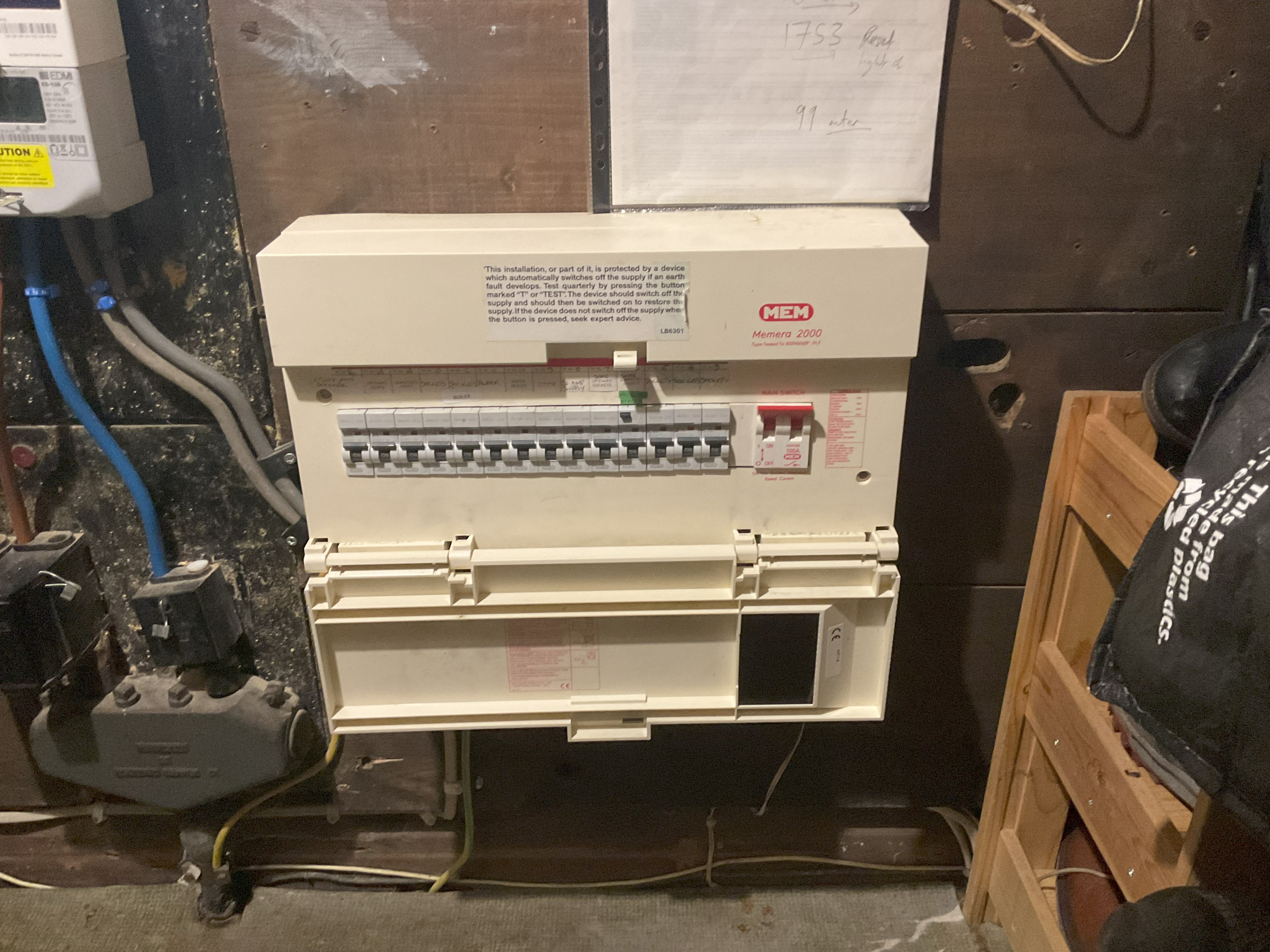
Old Board vs Modern Board — What You Actually Have
The type of consumer unit in your home determines what protection you actually have. Here is what each generation of board provides:
- Rewireable fuse board (Wylex-style, BS 3036) — fuse wire carriers, no circuit breakers, no RCDs, no TEST buttons. No electrocution protection on any circuit. The most outdated installation you will encounter in a UK property.
- Older plastic MCB board (no RCDs) — circuit breakers (MCBs) but no residual current protection. Overload and short circuit protection only. A step forward from fuse wire, but still lacking earth fault protection.
- Split-load board (MCBs + one or two shared RCDs) — the standard from the late 1990s to the mid-2010s. Some circuits are protected by RCDs; others may be on MCB-only sections and have no earth fault protection. Nuisance tripping is a common problem as modern electronic loads accumulate against the shared RCD threshold.
- Full RCBO consumer unit (metal enclosure) — every circuit has its own RCBO. Full protection on every circuit, no gaps, no cumulative leakage problem. The current 18th Edition recommended standard.
How to Tell if Your Board Has RCD Protection
You do not need to be an electrician to make this assessment. Look at the devices in your consumer unit:
- Devices with a TEST button — RCDs or RCBOs. Any circuit protected by one of these devices has residual current protection.
- Narrow switches with no TEST button — MCBs only. Circuits protected only by MCBs have no earth fault protection.
- One or two wider switches with TEST buttons, plus multiple narrow switches — a split-load board. Identify which circuits are behind the RCD-protected sections and which are not. Any circuit behind an MCB-only section has no electrocution protection.
If you are uncertain, Power Team Electrics can assess your consumer unit and advise on what protection is and is not in place.
Do You Need to Upgrade?
Your answer depends on what your board currently contains:
- MCBs only, no RCDs of any kind — no electrocution protection on any circuit. An upgrade is strongly recommended.
- Split-load board with shared RCDs — check whether all circuits are covered. If any circuits are on MCB-only sections, those circuits have no earth fault protection. Even where all circuits are covered, an RCBO board eliminates nuisance tripping and provides more robust per-circuit protection.
- Older board showing visible wear, corrosion, or overheating — an EICR is the appropriate starting point before deciding whether a full upgrade is required.
Power Team Electrics carries out both EICRs (Electrical Installation Condition Reports) and RCBO consumer unit upgrades across the Home Counties. An EICR gives you the full picture of what your installation contains and whether any circuits present a safety concern. An upgrade replaces your existing board with a modern 18th Edition compliant metal consumer unit, one RCBO per circuit, and a Surge Protection Device (SPD) fitted as standard.
Coverage
Power Team Electrics provides fuse board assessments, EICRs, and RCBO consumer unit upgrades across Surrey (Guildford), Kent (Maidstone), Essex (Chelmsford), Hertfordshire (St Albans), Berkshire (Reading), Buckinghamshire (Milton Keynes), and Sussex (Brighton).
All works are fully certified and compliant with BS 7671:2018 (18th Edition). Visit www.powerteamelectrics.co.uk to get a quote or book a survey.