
If your home still has a fuse board where faults are fixed by replacing fuse wire rather than resetting a circuit breaker, you have a rewireable fuse board. They were the standard installation in UK homes until the 1970s and 1980s, and a significant number of properties across the Home Counties still have them. They are also among the most dangerous electrical installations you will find in a residential property.
This guide explains exactly what a rewireable fuse board is, what makes it dangerous, and why upgrading it requires two things — not one — to do the job properly.
What Is a Rewireable Fuse Board?
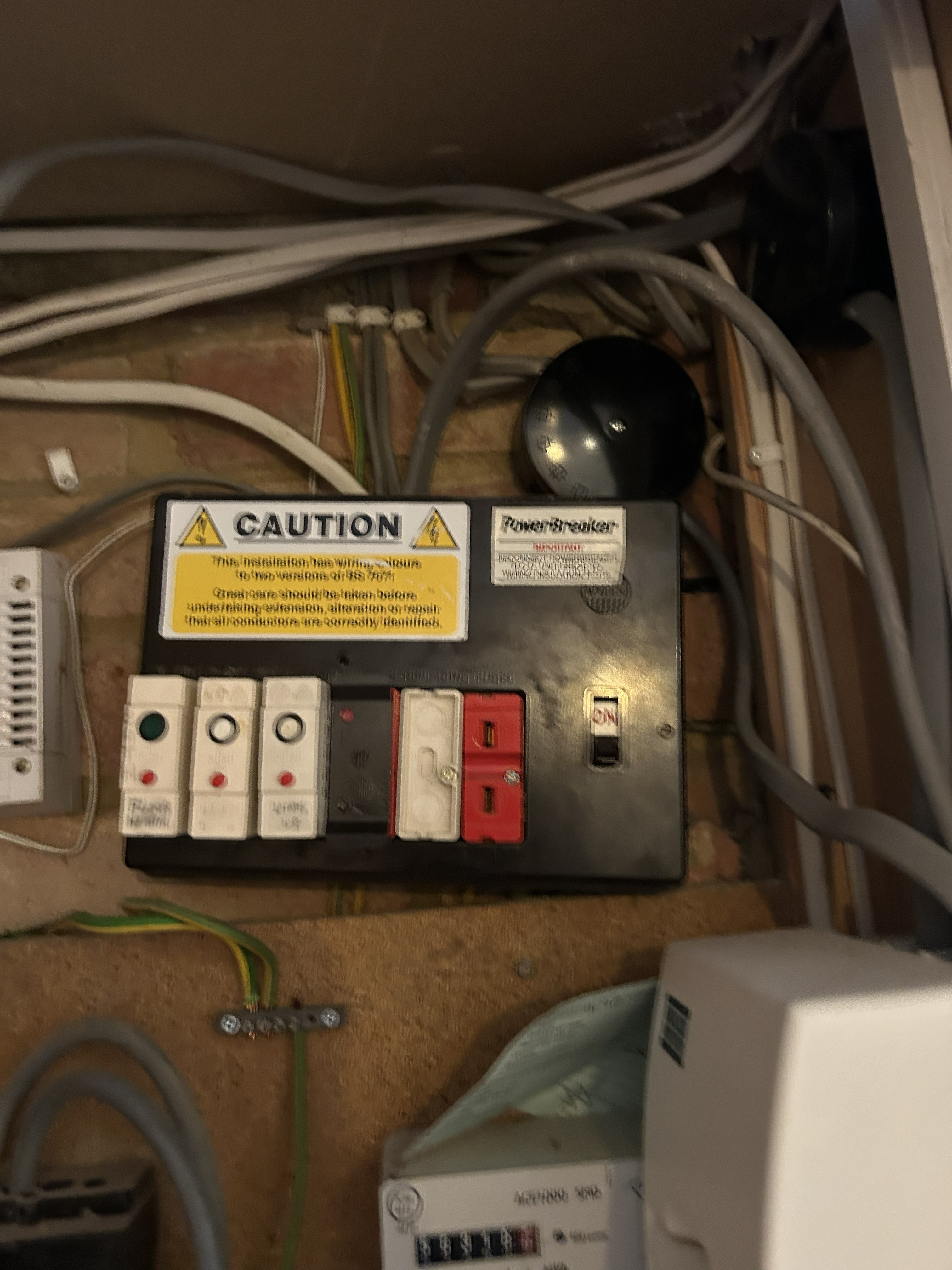
A rewireable fuse board uses fuse wire as its circuit protection. Each circuit has a ceramic fuse carrier that holds a length of wire rated to a specific current. When a fault occurs and too much current flows, the wire melts — breaking the circuit. To restore power, the homeowner must fit new fuse wire.
The most recognisable brand is Wylex, though you will also encounter Wirelex and generic units, many with Bakelite or early plastic enclosures. The individual fuse carriers — small rectangular cartridges that pull out of the board — are the defining visual feature. Each one contains the wire for one circuit.
Fuse wire was the only practical protection available at the time. It was designed to be the weakest point in the circuit — melting before the cable inside the wall could overheat. At the time of installation, this was the state of the art. Modern wiring regulations have moved on considerably since then, and the gap between what a rewireable board offers and what current standards require is significant.
Why Rewireable Fuse Boards Are Dangerous
There are six distinct reasons why a rewireable fuse board presents a greater risk than any modern consumer unit. They operate independently of each other — a property with a rewireable board is exposed to all six simultaneously.
1. Fuse Wire Generates Significant Heat
Fuse wire generates more heat than a modern MCB or RCBO under equivalent load conditions. That heat is continuous, produced every time the circuit carries any current. Over years and decades, this sustained heat degrades the surrounding components — contacts corrode, insulation becomes brittle, and the board deteriorates from the inside out. The degradation is largely invisible. There is no external indication that the board's condition is worsening.
2. Arcing When a Fuse Blows — The Service Fuse Risk
When fuse wire blows, it does not simply open the circuit cleanly like a modern MCB. It arcs — producing a burst of electrical discharge that, in older metal-encased boards, interacts with the metalwork and can produce a significant fault current event. In the worst cases, this arc can fracture the service fuse — the DNO-owned sealed component between the electricity meter and the consumer unit. Only the network operator can replace a service fuse. If it fractures, the property loses all power and cannot restore it until the DNO attends. The supply point itself may be compromised.
3. Wrong Fuse Wire — The Hidden Fire Risk
This is the most insidious danger specific to rewireable boards, and it has no equivalent in any modern consumer unit.
When fuse wire blows, the homeowner must replace it. The correct fuse wire rating is specific to the circuit — a lighting circuit requires thinner wire than a ring main. If the replacement wire is too thick — rated too high for the circuit — the fuse will not blow when it should. Instead, the cable in the wall overheats. The insulation melts. A fire starts inside the wall cavity. There is no external warning. No trip, no smell, no smoke — until the fire has already taken hold inside the structure.
This happens because people use whatever fuse wire they can find, do not know the correct rating for a given circuit, or deliberately fit thicker wire to stop a circuit from blowing repeatedly. There is no technical barrier preventing it. A modern MCB or RCBO is factory-calibrated and cannot be tampered with. Fuse wire has no such safeguard.
4. No Neutral Fault Protection
Neutral faults — where the neutral conductor becomes damaged or develops a fault — can cause cables to heat silently inside wall cavities. A rewireable board responds only to large overcurrent events on the live conductor. It cannot detect the smaller sustained imbalances that characterise a neutral fault and cause progressive heating over time. A dangerous fault can develop for months or years with no indication at the board and no trip to alert the occupant.
5. No RCD Protection — The Electrocution Risk
A rewireable fuse board provides zero RCD protection on any circuit. This is perhaps its most serious deficiency by modern standards.
An RCD (Residual Current Device) monitors the balance of current flowing out on the live conductor and returning on the neutral. If current escapes — into the earth, into a person, into water — the RCD detects the imbalance and trips in 30 to 40 milliseconds. This is the primary protection against electrocution.
Fuse wire does not respond to earth faults. It responds only to overcurrent — too much current on the live conductor. An earth fault through a person typically does not produce enough current to blow fuse wire. The fuse holds. Current continues to flow. The person continues to receive a potentially fatal electric shock.
There is no protection against:
- Drilling into a buried cable
- A faulty appliance with a live-to-earth fault
- Water ingress into a socket or appliance
- A child touching a live part that has become accessible due to damage
Every one of these scenarios can result in a fatal electrocution where RCD protection would have prevented it. A rewireable board offers none of it.
6. No Surge Protection
Under BS 7671:2018 Amendment 2, Surge Protection Devices (SPDs) are required on virtually all domestic electrical installations. A rewireable board has no surge protection of any kind. Every circuit is exposed to transient overvoltages from the mains supply — lightning-induced surges on overhead lines, grid switching events, and the repeated small surges generated by large appliances cycling on and off.
Modern homes are particularly vulnerable to surge damage. Heat pumps, smart boilers, EV chargers, and home electronics all contain sensitive microprocessors operating within a narrow voltage range. A rewireable board provides no protection for any of them.
How to Identify a Rewireable Fuse Board
You do not need to be an electrician to identify a rewireable fuse board. Look for the following:
- Individual fuse carriers — small rectangular cartridges that pull out from the board, each holding fuse wire. These are the defining feature of a rewireable board.
- No toggle switches or buttons — modern MCBs and RCBOs have rocker switches. A rewireable board has none.
- No TEST button — RCDs and RCBOs have a TEST button. A rewireable board has no such device.
- Bakelite or early plastic casing — often brown, black, or cream coloured, with a distinctive aged appearance.
- Brand markings — Wylex and Wirelex are the most common UK brands. The name is often printed on the cover or the board itself.
If you are not sure whether you have a rewireable board, the simplest check is: can you reset the circuit by flipping a switch, or do you need to replace something inside the fuse carrier? If the latter — it is rewireable.
What an Upgrade Requires — Two Things, Not One
When a rewireable fuse board is replaced, there are two separate pieces of work involved. Both matter. Carrying out only the first without the second leaves a significant safety issue unresolved.
1. Fuse Board Upgrade
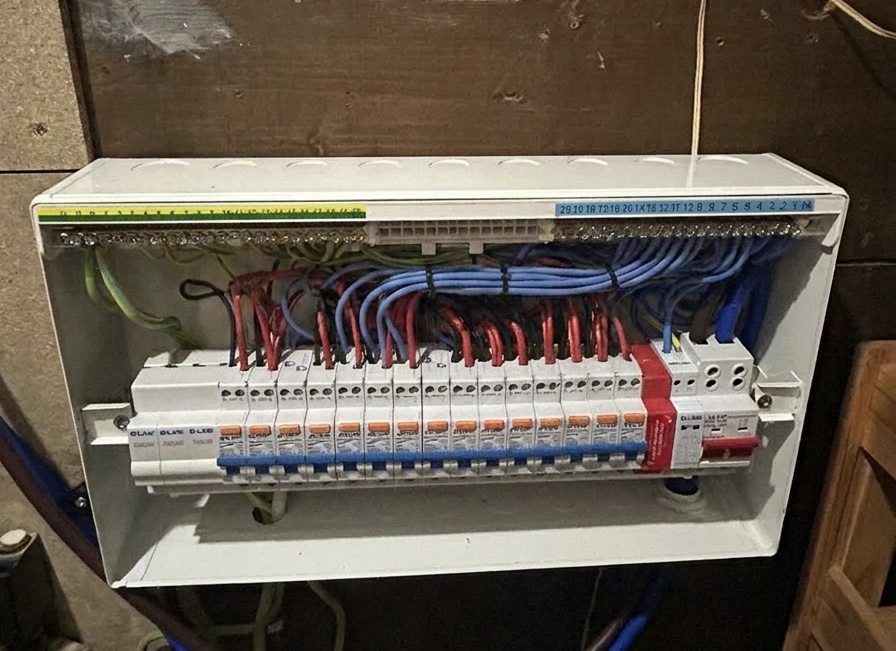
The board itself must be replaced with a modern 18th Edition compliant metal consumer unit with RCBOs on every circuit and a Surge Protection Device (SPD) as standard. This provides full RCD and overcurrent protection on every circuit, contains any fault event within the metal enclosure, and addresses the overheating, arcing, and fuse wire risks described above.
Consumer unit replacement is notifiable work under Part P of the Building Regulations. At Power Team Electrics, every fuse board upgrade is carried out and certified by a registered competent person. You receive a Part P certificate and an Electrical Installation Certificate on the day.
2. EICR (Electrical Installation Condition Report)
This is the step that is frequently overlooked — and it is critical.
A rewireable fuse board has no ability to detect faults on the wiring it serves. Silent, dangerous faults — deteriorating cable insulation, degraded rubber-sheathed wiring, loose or corroded junction box connections, neutral faults — may have been developing for years with no indication at the board and no trip to alert the occupant. The board has no mechanism to respond to them.
Wiring in properties with rewireable boards is typically equally aged. Properties with original 1960s or 1970s installations may have rubber-insulated cables that are now brittle, mineral insulated cables with degraded terminations, or wiring that was extended or modified at some point without proper certification. A new fuse board does not change the condition of this wiring. It merely provides better protection against future faults — it cannot resolve existing ones.
An EICR carried out alongside or immediately after a fuse board upgrade gives a complete picture of the installation's condition. If there are existing wiring faults that require remediation, the EICR identifies them. It is the only way to know what state the wiring behind the walls is actually in.
At Power Team Electrics, when we are already replacing the consumer unit, we offer reduced EICR pricing for the combined job. It is the most cost-effective time to carry out both.
Landlords: Additional Obligations
Under the Electrical Safety Standards in the Private Rented Sector (England) Regulations 2020, landlords are legally required to have the electrical installation in every rental property inspected at least every five years by a qualified electrician. A rewireable fuse board will almost certainly result in an Unsatisfactory EICR — the absence of RCD protection alone is a C2 observation. Landlords are then required to carry out all remedial work within 28 days. Non-compliance carries penalties of up to £30,000.
Coverage
Power Team Electrics carries out fuse board upgrades and EICRs across the Home Counties: Surrey (Guildford), Kent (Maidstone), Essex (Chelmsford), Hertfordshire (St Albans), Berkshire (Reading), Buckinghamshire (Milton Keynes), and Sussex (Brighton).
All works fully certified. 18th Edition compliant. Visit www.powerteamelectrics.co.uk to get a quote or book a survey.