
Your boiler packed up after five years instead of the fifteen it should have lasted. Your washing machine needed a new control board just two years after purchase. Your smart TV died suddenly with no warning and no obvious cause. These failures often get attributed to bad luck or poor build quality — but in many cases, the real culprit is something far less visible: a power surge.
Power surges — brief spikes in voltage above the standard 230V — happen constantly. They last microseconds. You will never notice one. Yet the energy they carry hits every circuit in your home simultaneously, and modern appliances with sensitive electronic components have no defence against them. A Surge Protection Device (SPD) at your consumer unit is the only way to protect everything connected to your wiring at once — and under current wiring regulations, it is now required on virtually every installation.
What Is a Power Surge?
A power surge (also called a transient overvoltage) is a brief, sudden spike in voltage above the normal 230V supply. Surges typically last between a few nanoseconds and a few milliseconds — too fast for a conventional circuit breaker to respond, too fast for you to notice, but fast enough to deliver a damaging burst of energy into every circuit connected to your consumer unit.
The UK mains supply is not as stable as it might appear. Voltage fluctuations are a normal feature of the distribution network, and for most of your wiring, that is not a concern — a light bulb or an electric radiator is inherently tolerant of voltage variation. The problem is that the modern home is full of components that are not.
What Causes Power Surges?
Surges enter your home through the electricity supply, and the sources are more varied than most people realise:
- Lightning strikes on overhead power lines — not a direct strike on your house, but a lightning strike anywhere near the overhead distribution network can inject a surge into the supply lines. This is particularly relevant in the Home Counties, where rural and semi-rural properties in Surrey, Kent, Berkshire, Hertfordshire, and Essex are commonly supplied via overhead lines.
- Grid switching events — utility companies regularly switch circuits in the distribution network to manage load or carry out maintenance. Each switching event generates a transient voltage spike that can propagate through the network to homes on that circuit.
- Large appliances cycling on and off — fridge compressors, washing machine motors, air conditioning units, EV chargers, and heat pumps all generate small surges on your own wiring when their motors start and stop. The surge is small, but it happens repeatedly, multiple times per day.
- Ageing distribution infrastructure — older network components generate more electrical noise and voltage disturbances as they approach end of life.
How Power Surges Silently Damage Appliances
Modern appliances — boilers, smart televisions, computers, heat pumps, EV chargers, washing machines, tumble dryers — contain sensitive electronic components and microprocessors operating within a specific, narrow voltage range. These components were not designed to handle spikes above 230V, and they have no built-in defence against transient overvoltages.
Damage happens via two distinct mechanisms:
Catastrophic Failure
A single large surge — typically from a nearby lightning strike — can destroy a sensitive component outright. The energy overwhelms the component instantly. The boiler control board fails. The television will not power on. The effect is immediate and unmistakable.
Cumulative Degradation
This is the more insidious and far more common mechanism. Each small surge causes microscopic damage to the electronic components it passes through. Individually, no single event is sufficient to cause failure. The appliance keeps working. There is no visible sign that anything is wrong. But every surge weakens the components a little further — like metal fatigue in an aircraft wing.
The result is that appliances fail years earlier than they should, with no obvious explanation. The boiler that should last fifteen to twenty years fails at eight. The washing machine that should give twelve years of service needs a new control board at four. The cause is rarely identified. The explanation — power surges — is invisible by definition.
What an SPD Does
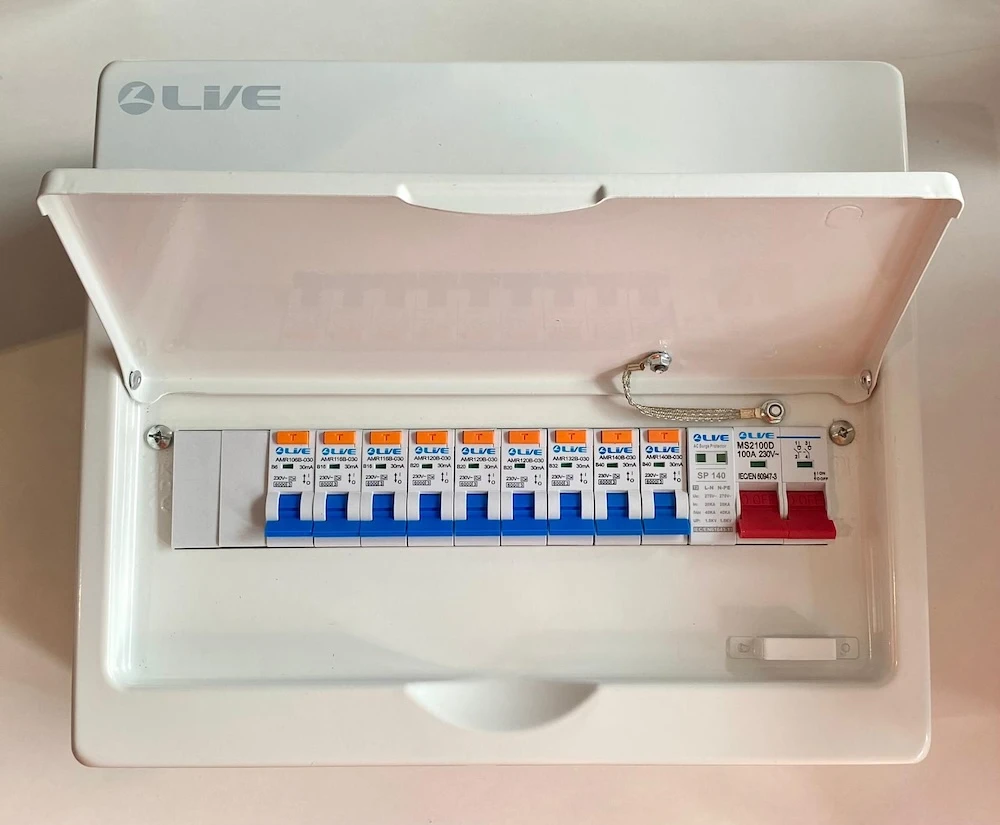
A Surge Protection Device fitted at the consumer unit monitors the voltage of the incoming supply continuously. When it detects a transient overvoltage, it clamps the voltage by absorbing the excess energy and diverting it safely to earth before it can reach the circuits and appliances connected to the board.
An SPD operates in nanoseconds — orders of magnitude faster than any circuit breaker or fuse. By the time a conventional protective device could begin to respond, the SPD has already clamped the surge and returned the voltage to normal. You never notice the SPD operating. There is no trip, no alarm, no indication. It simply absorbs the energy and does its job.
At the heart of every SPD is a Metal Oxide Varistor (MOV) — a component whose resistance drops dramatically when the voltage across it rises above a set threshold. This allows it to conduct excess current to earth during a surge, while remaining invisible to the normal operation of the circuit under normal voltage conditions. An SPD is entirely passive in normal use and requires no maintenance.
Types of SPD: Which Does Your Property Need?
| Type | Location | Designed to Handle | When Required |
|---|---|---|---|
| Type 1 | At or near the service head | Direct lightning-induced surges from overhead power lines | Mandatory where the property is supplied via overhead lines |
| Type 2 | At the consumer unit | Conducted surges propagating through the distribution network | Required under 18th Edition for virtually all domestic installations |
| Type 1+2 Combined | At the consumer unit or service head | Both lightning-induced and conducted surges in a single device | Recommended for properties with an overhead line supply |
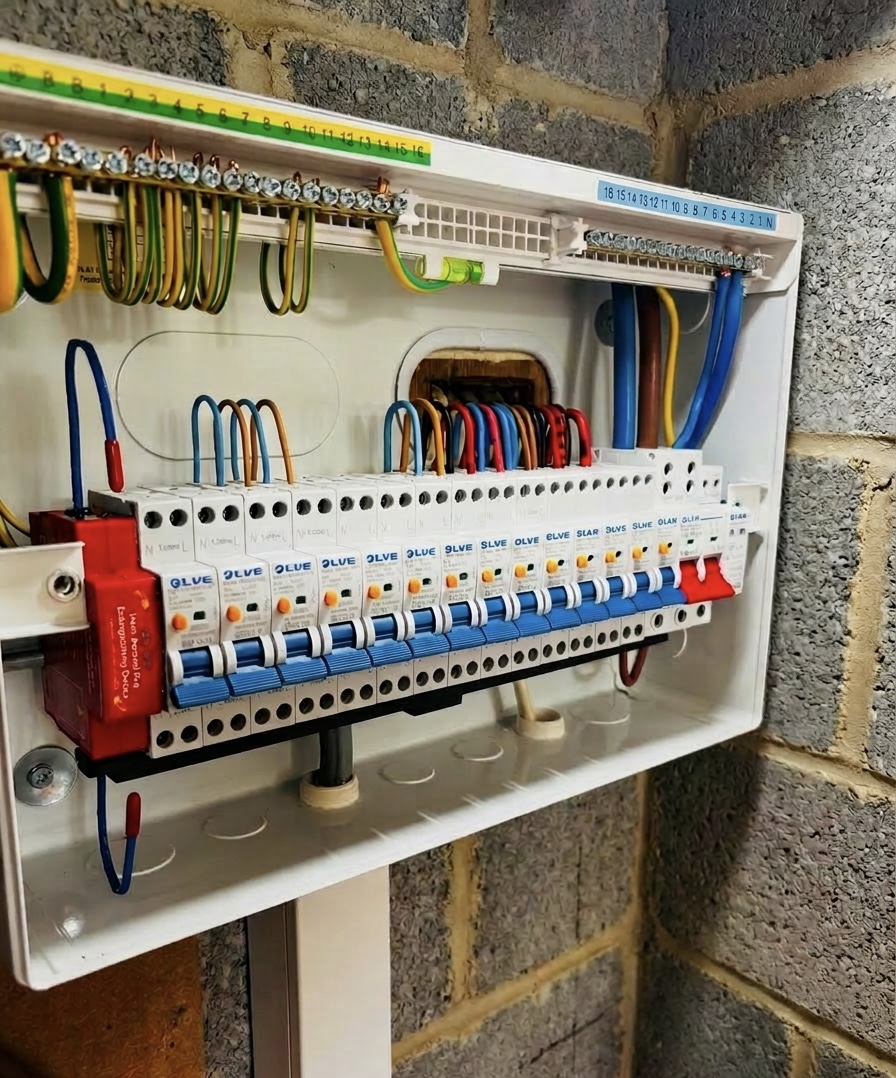
For most urban and suburban properties supplied by an underground cable, a Type 2 SPD at the consumer unit provides the appropriate level of protection. For rural and semi-rural properties supplied by an overhead line, a Type 1 or Type 1+2 SPD is required under BS 7671:2018 Amendment 2. Many properties across rural Surrey, Kent, Berkshire, Hertfordshire, and Essex fall into this category.
What the 18th Edition Requires
BS 7671:2018 Amendment 2, Regulation 443 requires SPDs to be installed in all electrical installations where the consequence of an overvoltage would be unacceptable — which, in practice, means virtually every domestic property in the UK.
Where an installation is supplied via overhead lines, the requirement to fit a Type 1 or Type 1+2 SPD is explicit and mandatory. For underground-supplied properties, the regulation creates a strong obligation to provide surge protection as standard.
If your consumer unit is being replaced — whether as part of a fuse board upgrade, an EV charger installation, or any other notifiable electrical work — the new consumer unit must be installed with an SPD. At Power Team Electrics, we fit surge protection as standard on every fuse board upgrade we carry out.
Is a Plug-In Surge Protector Enough?
Plug-in surge protectors do provide a degree of protection for the appliances plugged into them. But they have a fundamental limitation that makes them inadequate as a whole-house solution: a plug-in surge protector only protects appliances that are physically plugged into it. It cannot protect any hardwired appliance.
Consider what is hardwired in a typical UK home:
- The boiler — hardwired to a fused spur
- The heat pump — if installed, hardwired
- The EV charger — hardwired to a dedicated 32A circuit
- Built-in oven and hob — hardwired
- The immersion heater or hot water cylinder controller — hardwired
- Fixed lighting with LED drivers and smart controls — hardwired
None of these can be connected to a plug-in surge protector. They are all exposed to any surge that reaches the consumer unit. The only protection that covers every circuit simultaneously — hardwired and socket-connected alike — is an SPD installed at the consumer unit.
The Cost-Saving Argument
The financial case for an SPD is straightforward when you consider what it is protecting:
- A modern combi boiler: £1,500–£3,000 installed. Replacement of a surge-damaged control board: several hundred pounds plus the cost of no heating.
- A heat pump: £8,000–£15,000 installed. Control electronics are highly sensitive to overvoltage.
- A smart television: £500–£2,000.
- A high-specification computer: £1,000 or more.
- An EV charger with smart electronics: £600–£1,000 installed.
A single SPD at the consumer unit protects all of these simultaneously. The cost of adding an SPD to a consumer unit upgrade is modest relative to the upgrade itself — and trivial relative to a single premature appliance replacement it prevents.
When a consumer unit upgrade is already being carried out, the marginal cost of including an SPD is low. It is the most cost-efficient moment to add this protection, which is why Power Team Electrics includes it as standard on every board we install.
Home Counties: Why Rural Properties Are at Higher Risk
Surge risk is not uniform across the country. Properties in rural and semi-rural areas of the Home Counties face a meaningfully higher risk from lightning-induced surges because of their supply infrastructure.
A significant proportion of homes across rural Surrey, Kent, Berkshire, Hertfordshire, and Essex are still supplied via overhead power lines rather than underground cables. When lightning strikes near an overhead line — it does not need to be a direct strike, just close — the induced voltage spike propagates along the line and into every property connected to it.
The 18th Edition makes this explicit: overhead-supplied properties require a Type 1 or Type 1+2 SPD. If your property is supplied via an overhead cable — visible running from a pole to the house rather than entering underground — this applies to you.
Rural Home Counties households have also seen significant increases in the value of the equipment at risk. Heat pumps, EV chargers, smart home systems, and premium appliances mean the typical modern rural home contains considerably more surge-sensitive electronics than it did ten years ago.
Coverage
Power Team Electrics fits surge protection devices as standard on every consumer unit upgrade across the Home Counties: Surrey (Guildford), Kent (Maidstone), Essex (Chelmsford), Hertfordshire (St Albans), Berkshire (Reading), Buckinghamshire (Milton Keynes), and Sussex (Brighton).
All works are fully certified and compliant with BS 7671:2018 (18th Edition). Visit www.powerteamelectrics.co.uk to get a quote or book a survey.