Buying a home EV charger should be straightforward. In practice, it rarely is. Walk into any conversation about home charging and you'll quickly find yourself drowning in competing brand claims, confusing technical specifications, and no shortage of opinion from people who bought one product and consider the matter settled.
This guide cuts through all of that. Power Team Electrics installs all eight chargers covered below across Surrey, Kent, Essex, Hertfordshire, Berkshire, Buckinghamshire, and Sussex — and we've put together this guide to help you make the right decision for your home, your car, and your budget before you spend a penny.
What to Know Before You Buy
Before we get into individual products, there are three questions worth answering first.
Does my home have a single-phase or three-phase supply?
This is the single most important technical question you need to answer.
The vast majority of UK homes are single-phase. If you live in a standard residential property — a terrace, semi, or detached house — you almost certainly have a single-phase supply. This limits your home EV charger to a maximum output of 7kW, which is the standard for home charging across the UK.
Three-phase supplies are found in some larger or older properties, commercial premises, and rural buildings. If you have three-phase, you can access chargers rated at up to 22kW — but only if your car can also accept three-phase AC charging (many cannot).
If you're not sure which supply you have, your Power Team Electrics engineer will confirm this during the survey visit.
Tethered vs Socketed: Which Should You Choose?
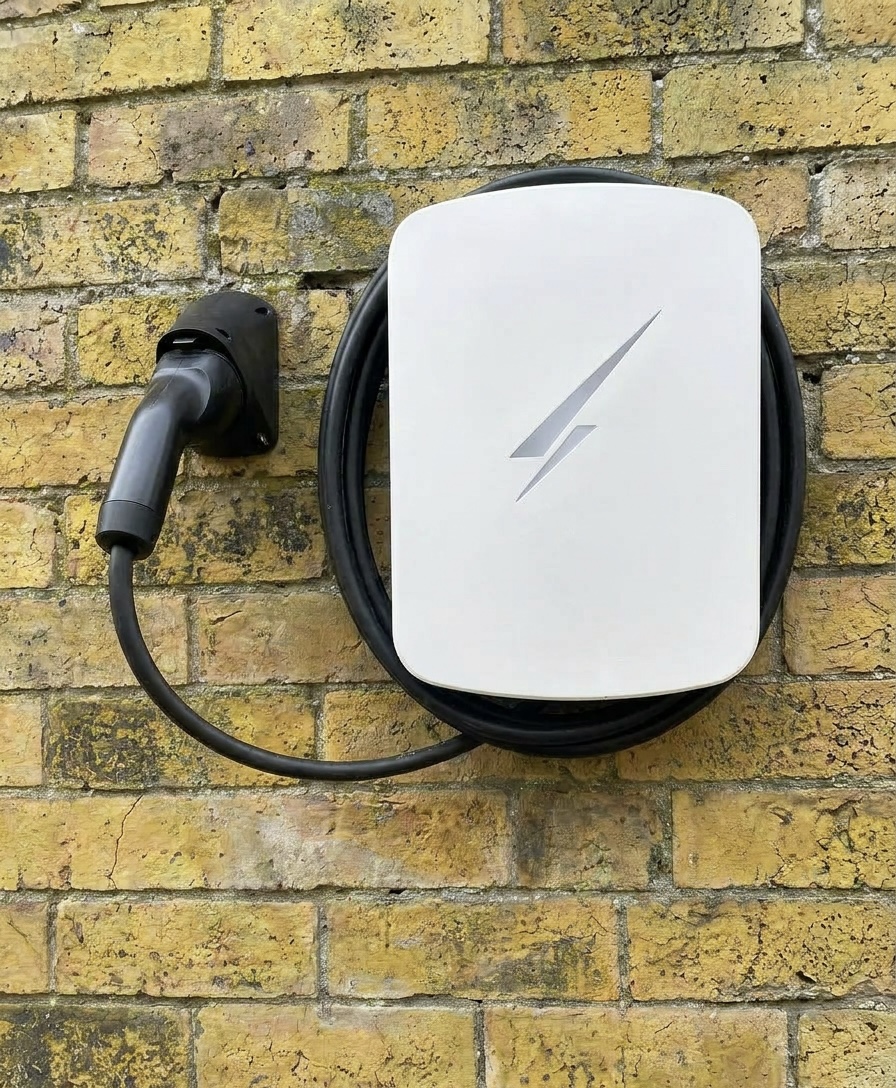
Tethered chargers come with a cable permanently attached to the unit. You plug it straight into your car. No fuss, no rummaging for a cable. This is the more convenient option for day-to-day use, and it's what most UK drivers choose.
Socketed chargers have a Type 2 socket on the unit instead of a built-in cable. You supply your own Type 2 cable, plug one end into the charger and the other into your car. This has two advantages: first, the unit looks cleaner on the wall when not in use; second, if cable standards ever change, or if a future car uses a different connector format, you simply replace the cable rather than the whole charger.
Recommendation: If you drive one car and value convenience, go tethered. If you have two EVs in the household or want maximum future-proofing, consider socketed.
Single-Phase vs Three-Phase: A Plain-Language Summary
| Single-Phase | Three-Phase | |
|---|---|---|
| Maximum home charger output | 7kW | Up to 22kW |
| Typical UK domestic supply | Yes — the overwhelming majority | Rare in residential properties |
| Typical full charge (60kWh battery) | ~8-9 hours overnight | ~3 hours (only if car accepts 3-phase AC) |
| Is overnight charging sufficient on single-phase? | Yes, for almost all drivers | N/A |
| Three-phase chargers available | BG Sync, Tesla Wall Connector, Rolec Evo, EasyOne | Same models |
For most homeowners, single-phase 7kW charging is completely sufficient. Plugging in overnight — as you would your phone — means waking up to a full battery every morning.
The 8 Best Home EV Chargers — Compared
1. BG Sync
Best for: Budget-conscious buyers who want reliable simplicity
The BG Sync is the no-nonsense option. It does exactly what a home EV charger needs to do — charge your car, reliably, every time — without complicating matters with app integrations, tariff management, or design awards.
It comes as a tethered unit with a 7.5m cable, which is long enough to reach most home parking arrangements comfortably. Both single-phase (7kW) and three-phase (22kW) versions are available.
- Pros: Most affordable option across our range; tethered with a generous 7.5m cable; available in single-phase and three-phase; simple, proven reliability.
- Cons: Limited smart features compared to premium alternatives; design is functional rather than stylish.
If your priority is getting your car charged at the lowest cost without any fuss, the BG Sync delivers exactly that. There is real value in simplicity.
2. Tesla Wall Connector
Best for: Tesla owners — and anyone who wants a premium charging experience
The Tesla Wall Connector has been updated to include a Type 2 connector, which means it is fully compatible with any electric vehicle on UK roads — not just Teslas. The unit is sleek, minimal, and unmistakably premium. Both single-phase (7kW) and three-phase (22kW) versions are available.
- Pros: Iconic Tesla branding and premium finish; compatible with any EV via Type 2 connector; available in single-phase and three-phase; robust build quality backed by a global install base.
- Cons: Premium price point.
For Tesla drivers, there really is no better option for the home. For non-Tesla owners who want a charger that projects confidence and premium taste — the Tesla Wall Connector absolutely delivers.
3. Rolec Evo
Best for: Budget buyers who also have — or plan to have — solar panels
The Rolec Evo punches above its price point, particularly for homes with solar PV systems. It is a socketed unit — a 5m or 7.5m Type 2 cable can be purchased separately. Both single-phase (7kW) and three-phase (22kW) variants are available.
- Pros: Competitive price point; good solar integration; stylish and compact design; socketed for a tidier wall appearance; single-phase and three-phase available.
- Cons: Tethered cable sold separately; solar integration not as advanced as the myenergi Zappi.
4. Ohm ePod
Best for: Buyers who want to minimise running costs through smart tariff switching
The Ohm ePod has one standout feature: best-in-class tariff integration technology. Specialist EV electricity tariffs offer dramatically cheaper rates during off-peak overnight windows — as low as 3p per kWh on some tariffs, compared to a standard rate of around 24p. Over the lifetime of a vehicle, the difference is enormous. This is a single-phase only unit.
- Pros: Unmatched tariff integration — charges at the cheapest available rate automatically; excellent long-term running cost savings; 7kW single-phase.
- Cons: Single-phase only; tariff savings depend on switching to a specialist EV tariff.
5. Sync Energy Link
Best for: Installations with limited space or anyone who wants minimal visual impact
The Sync Energy Link is the smallest EV charger commercially available in the UK — genuinely as discreet as an outdoor socket. Designed for no-driveway installations, listed buildings, conservation areas, or homeowners who simply want minimal visual impact, it also comes with its own consumer unit as standard. This is a single-phase only unit.
- Pros: Smallest EV charger on the market; includes its own consumer unit as standard; ideal for street-facing or space-constrained installations.
- Cons: Single-phase only; compact design limits smart features.
6. Hypervolt
Best for: Buyers who want the highest-rated product and premium aesthetics
The Hypervolt is consistently rated among the top home EV chargers in the UK. Available in three finishes — black, graphite, or white — and offering three cable lengths: 5m, 7.5m, and 10m, it has the widest tethered cable range on this list. This is a single-phase only unit at 7kW.
- Pros: Top-rated home EV charger in the UK by customer satisfaction; stylish in three finishes; tethered with 5m, 7.5m, or 10m cable options; consistent quality and reliability.
- Cons: Single-phase only; premium price for a single-phase unit.
If you want to buy the charger that most owners would buy again without hesitation, buy the Hypervolt.
7. EasyOne
Best for: Aesthetics-conscious buyers who want their charger to complement their home
The EasyOne is the most visually distinctive home EV charger on this list, available in five colours: white, black, blue, red, and grey. It is a socketed unit. Both single-phase and three-phase versions are available.
- Pros: Most distinctive design available; five colour options; socketed with 5m or 7.5m cable; single-phase and three-phase available.
- Cons: The bold design won't appeal to everyone; socketed — cable management required.
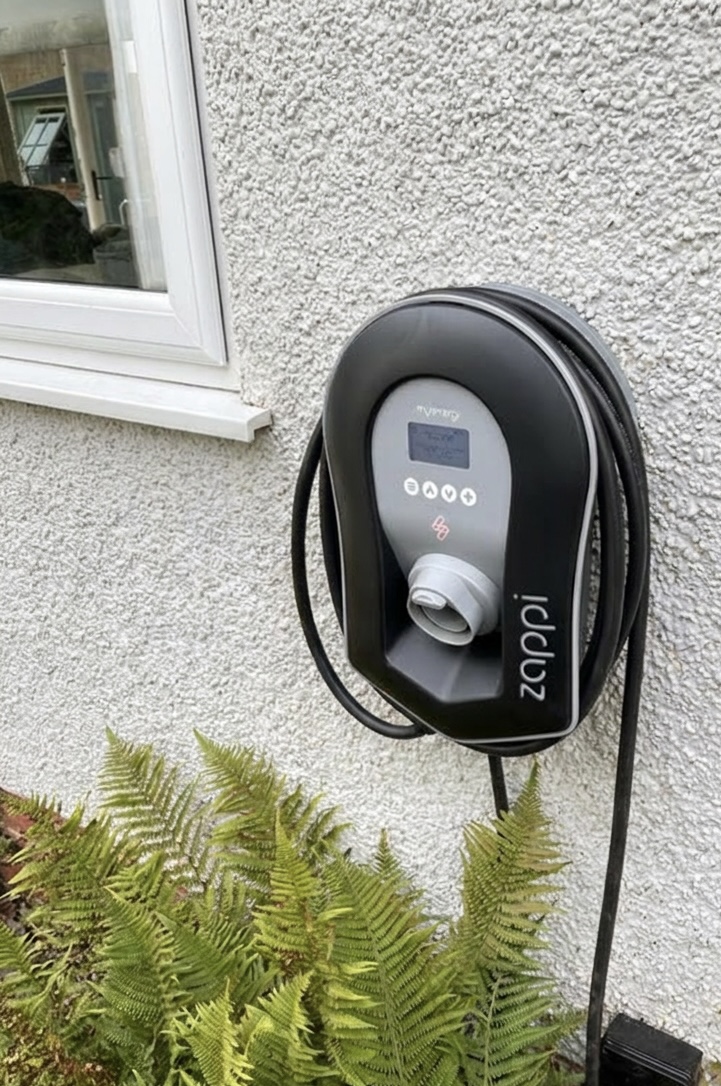
8. myenergi Zappi
Best for: Solar panel owners or anyone with a renewable energy system
When it comes to solar integration, the myenergi Zappi is in a category of its own. It works in three modes: boost mode (full speed regardless of solar), fast mode (solar plus grid), and eco mode (solar surplus only — zero grid power). The trade-off is size: the Zappi is the bulkiest unit on this list. This is a single-phase only unit.
- Pros: Best-in-class solar and renewable energy integration; three charging modes including pure solar eco mode; highly rated by UK owners; strong myenergi ecosystem.
- Cons: Single-phase only; noticeably bulky design; higher price point.
For solar panel owners, the Zappi is not just the best choice — it is arguably the only responsible one.
Comparison Table: All 8 Chargers at a Glance
| Charger | Type | Phases | Cable | Best For |
|---|---|---|---|---|
| BG Sync | Tethered | Single + Three | 7.5m included | Budget buyers wanting reliable simplicity |
| Tesla Wall Connector | Tethered | Single + Three | Included | Tesla owners and premium buyers |
| Rolec Evo | Socketed | Single + Three | Sold separately (5m/7.5m) | Budget buyers with solar panels |
| Ohm ePod | Tethered | Single only | Included | Minimising running costs via tariff integration |
| Sync Energy Link | Socketed | Single only | Included | Discreet installs and street-facing walls |
| Hypervolt | Tethered | Single only | 5m, 7.5m, or 10m | Highest-rated charger, premium aesthetics |
| EasyOne | Socketed | Single + Three | 5m or 7.5m supplied | Aesthetics-focused buyers, five colour choices |
| myenergi Zappi | Socketed | Single only | Separate | Solar panel owners and renewable energy systems |
Do I Need a New Fuse Board Before Installing an EV Charger?
Not always — but it depends on your existing board. Part P regulations require that any EV charger installation is carried out by a certified electrician and that your consumer unit is capable of safely supporting the new load.
Older fuse boards — particularly those with rewireable fuses or plastic consumer units — may need upgrading before a charger can be installed. In some cases, your engineer will recommend an EICR (Electrical Installation Condition Report) to confirm the condition of your existing wiring before work begins.
Power Team Electrics carries out fuse board upgrades alongside EV charger installations where required. Our installations are Part P certified and 18th Edition compliant.
How Much Does a Home EV Charger Installation Cost?
Installation costs vary depending on your property type, the location of your fuse board, cable routing requirements, and whether any additional electrical work is needed. As a general guide, a standard home EV charger installation typically falls in the range of £750 to £1,200 all-in, including the charger unit, labour, and certification.
For landlords or those with off-street parking at a rental property, the OZEV landlord grant may apply — ask us about eligibility when you enquire.
Why Choose Power Team Electrics for Your EV Charger Installation?
Power Team Electrics installs all eight chargers in this guide across the Home Counties — including Surrey (Guildford), Kent (Maidstone), Essex (Chelmsford), Hertfordshire (St Albans), Berkshire (Reading), Buckinghamshire (Milton Keynes), and Sussex (Brighton).
Every installation is:
- Part P certified — a legal requirement for EV charger and electrical work
- 18th Edition compliant — meeting the current wiring regulations
- Carried out to a standard we're genuinely proud of — no cutting corners, no rushing, no leaving a mess
We believe EV charger installation should be straightforward and transparent. We'll give you a clear price, turn up when we say we will, and make sure your charger works properly before we leave.