
If your RCD trips repeatedly with no obvious cause — cutting power to half the house, sometimes in the middle of the night, sometimes for no reason you can identify — you are almost certainly experiencing nuisance tripping. It is one of the most common electrical complaints in UK homes, and it is becoming more common every year as the average household fills with modern electronics.
The reassuring news: nuisance tripping is not a sign that your home has a dangerous fault. The frustrating news: it is a structural limitation of older consumer units — and it will not go away on its own. This guide explains exactly what is happening, why modern homes are particularly vulnerable, and what the permanent solution looks like.
What Is an RCD and the 30mA Threshold?
An RCD (Residual Current Device) is a safety device that monitors the balance between the current flowing out on the live conductor and the current returning on the neutral. In a healthy circuit, these values are equal. If current is escaping — into the earth, into the structure, or through a person — the balance is lost. The RCD detects this imbalance and trips the circuit in approximately 30 to 40 milliseconds.
The standard trip threshold is 30mA of residual current. This figure is not arbitrary — it reflects research into human physiology. Cardiac fibrillation can occur if alternating current at 30mA flows through the body for more than around 100 milliseconds. An RCD at 30mA trips in well under that window. This is why RCDs save lives in fault conditions.
In older homes with simple appliances — resistive loads like incandescent light bulbs, electric fires, and basic heating — the 30mA threshold was almost never reached unless there was a genuine fault. The earth conductors in those circuits carried almost no current during normal operation. That world no longer exists.
Why Modern Homes Are Different
The average UK home in 2025 contains dozens of devices with switch-mode power supplies: laptops, desktop computers, monitors, smart televisions, broadband routers, gaming consoles, phone chargers, smart home hubs, LED lighting, and hybrid boilers. Each of these devices uses the earth conductor to dump small amounts of electronic interference and leakage current as part of normal, intended operation.
Individually, the leakage from any one of these devices is well below the 30mA trip threshold — typically in the range of 0.5mA to 3mA per device. Under any reasonable interpretation, none of them has a fault.
The problem is not with any individual device. The problem is cumulative. In a split-load consumer unit — the type with one or two shared RCDs protecting groups of circuits — a single RCD monitors every circuit behind it simultaneously. The leakage from every device on every circuit it covers adds together against a single 30mA threshold. Ten devices contributing 3mA each reaches 30mA. When that combined total reaches the threshold, the RCD trips — even though no single device is faulty.
This is nuisance tripping: an RCD responding exactly as designed, to a cumulative leakage level that looks like a fault but is produced entirely by healthy, normal appliances operating as their manufacturers intended.
Can LED Lights Cause RCD Tripping?
Yes — and this surprises many homeowners who have replaced their old incandescent bulbs expecting an improvement in every respect.
LED bulbs do not draw current directly from the mains. They each contain a small electronic driver that converts the mains supply to a lower direct current voltage suitable for the LED chips. Every one of those drivers produces a small amount of earth leakage current as part of normal operation.
In a typical room with ten LED downlights, the lighting circuit might contribute 5–10mA of leakage. This is not a problem in isolation. But if that same RCD also covers a ring main with several computers and phone chargers, the combined total may tip the device over its 30mA threshold — particularly when a new appliance is plugged in, or when a surge event briefly increases the leakage spike.
The transition from incandescent to LED is one of the reasons nuisance tripping has become significantly more prevalent in UK homes since roughly 2015.
Can Computers Cause RCD Tripping?
Yes. Switch-mode power supplies — the type used in all modern computers, laptops, monitors, gaming consoles, and televisions — inherently generate earth leakage as a consequence of the way they operate. The leakage is a by-product of the filtering components inside the power supply, designed to suppress electromagnetic interference from reaching the mains supply and other connected devices.
A home office with a desktop computer, two monitors, a laptop, a printer, and a network switch might contribute 10–15mA of leakage to the ring main circuit. None of these devices has a fault. They are operating exactly as certified. But combined with leakage from a lighting circuit and other circuits behind the same shared RCD, the cumulative total may reach or exceed the 30mA trip threshold — reliably, repeatedly, and without any straightforward explanation visible to the homeowner.
Why Does My RCD Trip at Night?
Night-time tripping is one of the most disorienting variants of this problem, and it has a specific explanation.
Most modern appliances generate leakage even in standby — routers, smart home devices, televisions on standby, and alarm systems continue to draw small amounts of current and produce earth leakage around the clock. In a home where the background leakage from always-on devices is already at, say, 25mA, the system is operating close to the trip threshold even with very little active load.
What pushes it over the edge at night is typically the fridge compressor starting. When a fridge compressor motor starts, it generates a brief current spike that momentarily increases the leakage seen by the RCD. On a board where background leakage is already near the threshold, this spike is enough to trip the RCD. The fridge itself is not faulty. The RCD is working exactly as intended. The problem is the architecture of the board.
Nuisance Tripping vs a Genuine Fault — an Important Distinction
Before concluding that your RCD trips are nuisance events, it is important to rule out a genuine earth fault. Not all RCD tripping is nuisance tripping, and the difference matters.
- If the RCD trips immediately when a specific appliance is switched on — and does not trip at other times — the appliance almost certainly has a genuine earth fault. Disconnect and test or replace it. Do not assume this is nuisance tripping.
- If the RCD trips at seemingly random intervals, or when multiple devices are running simultaneously, with no single clear trigger — this is the pattern consistent with nuisance tripping from cumulative earth leakage.
If you are uncertain, do not attempt to diagnose this yourself. A qualified electrician can carry out leakage current testing on individual circuits and appliances to determine whether a genuine fault exists, and identify which circuit or device is responsible.
The key rule: never assume all tripping is nuisance tripping and ignore it. Investigate, identify the pattern, and if in doubt call an electrician. Nuisance tripping and a genuine protective trip can look identical from the outside.
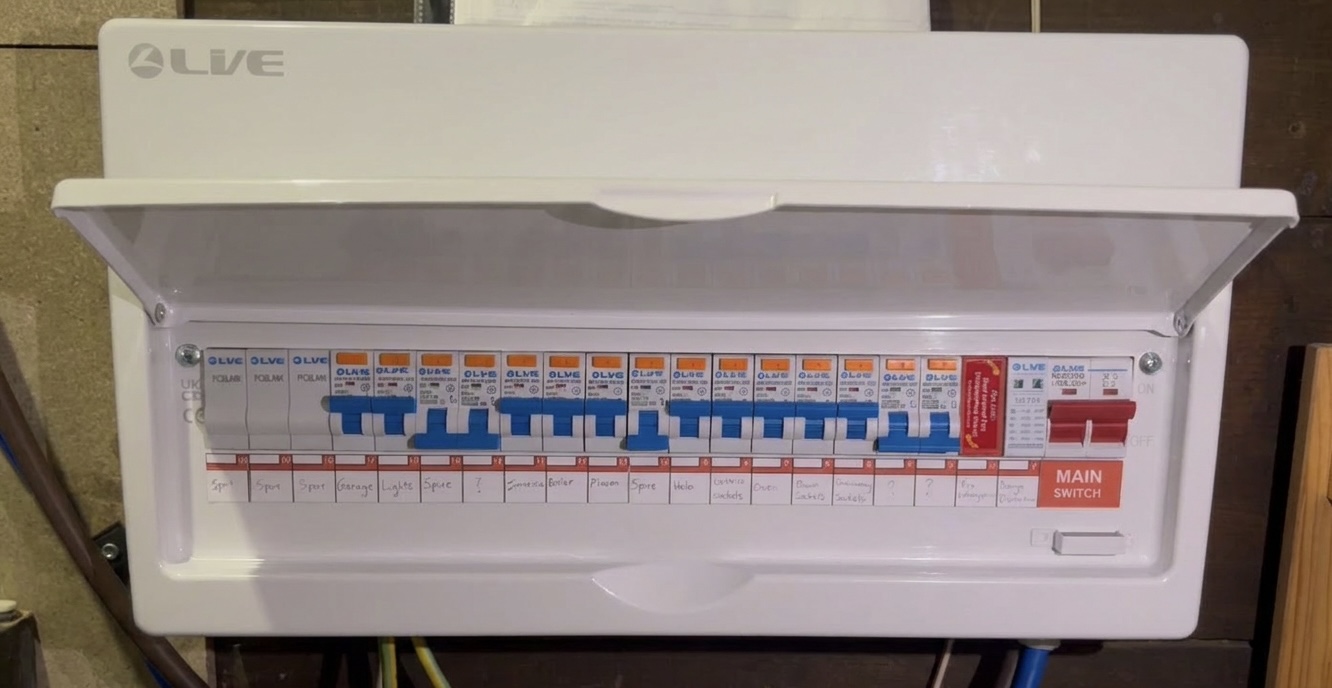
The RCBO Solution: Why an RCBO Consumer Unit Fixes Nuisance Tripping
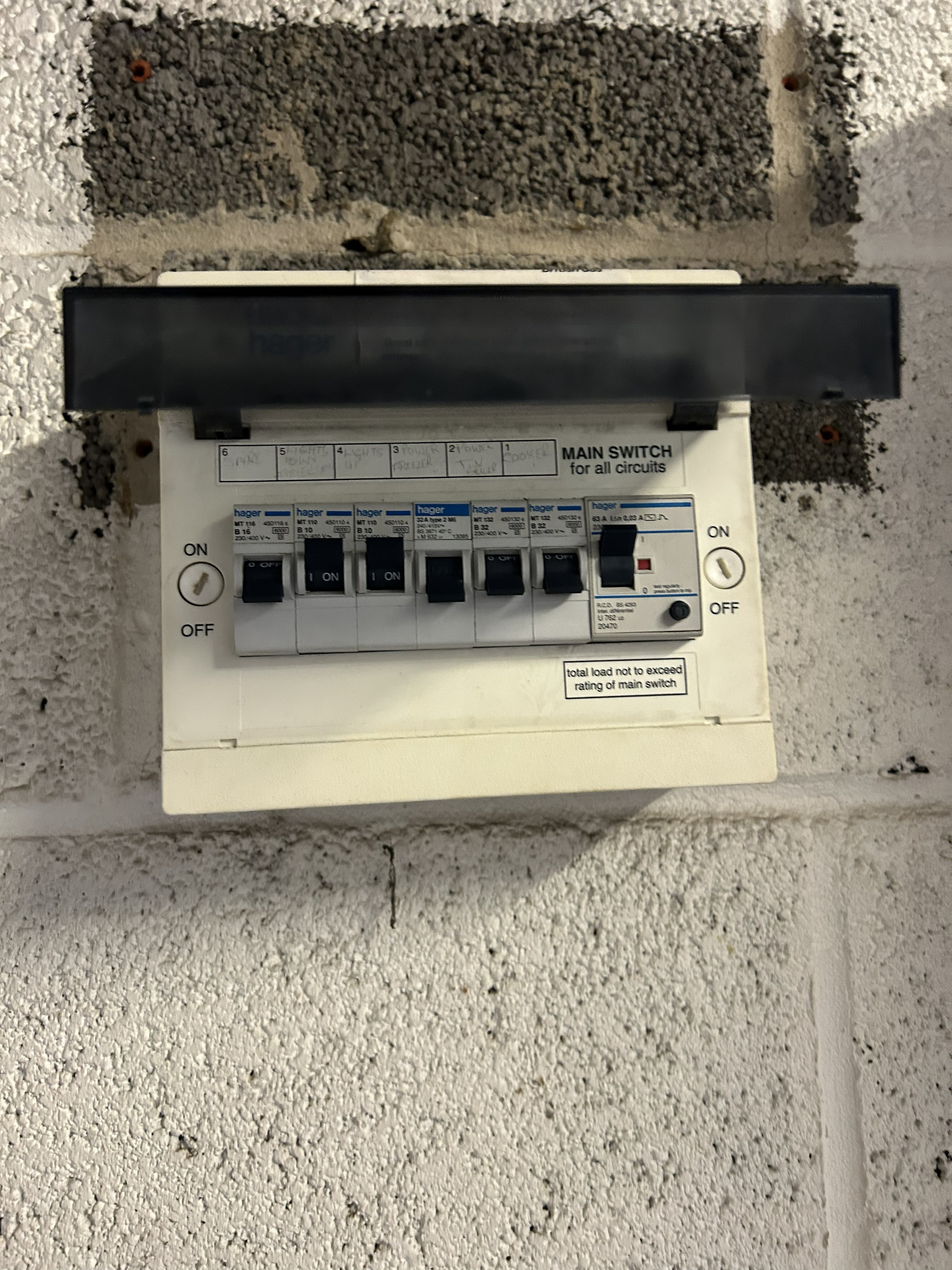
The architecture of a split-load consumer unit — where a single RCD protects multiple circuits simultaneously — is the root cause of the nuisance tripping problem. The solution is to change the architecture.
An RCBO consumer unit replaces every circuit's protective device with an individual RCBO (Residual Current Breaker with Overcurrent protection). An RCBO combines the earth fault protection of an RCD with the overload and short circuit protection of an MCB in a single device, dedicated to one circuit only.
In an RCBO board:
- Each circuit has its own RCBO monitoring only that circuit's current
- The leakage from the lighting circuit is measured only against its own 30mA threshold
- The leakage from the ring main is measured only against its own 30mA threshold
- The leakage from every other circuit in the house never accumulates against any single device's threshold
The cumulative leakage problem disappears entirely. No single circuit, in a normal home with normal appliances, produces enough earth leakage to trip its own dedicated RCBO.
There is an additional benefit that goes beyond nuisance tripping. When an RCBO consumer unit does trip — because of a genuine fault — only the circuit with the fault loses power. The rest of the house remains live. The tripped RCBO, clearly labelled, identifies the faulted circuit immediately. You do not lose the entire upstairs lighting because a socket in one room has a fault. You do not lose the fridge, the alarm, and the broadband because the circuit covering half the ring main has tripped.
An RCBO consumer unit also brings your installation up to the standard recommended by BS 7671:2018 (18th Edition) — the current edition of the IET Wiring Regulations. This matters for landlords maintaining regulatory compliance, for homeowners selling their property, and for anyone who has recently had an EICR with observations about their existing board.
What an RCBO Consumer Unit Upgrade Involves
- Survey and assessment — we review your existing consumer unit, the number of circuits, the available supply capacity, and the earthing and bonding arrangement.
- Isolation and removal — the existing consumer unit is safely isolated and removed.
- Installation — a new 18th Edition compliant metal RCBO consumer unit is fitted, with one RCBO per circuit and a Surge Protection Device (SPD) as standard on every board we install.
- Testing — the full installation is tested to BS 7671:2018 requirements before we leave.
- Certification — an Electrical Installation Certificate is issued under Part P on the day, with a full test schedule included.
Consumer unit replacement is Part P notifiable work under the Building Regulations. All consumer unit upgrades are carried out and certified by a registered competent person — the certificate we provide is the formal record of compliance accepted by insurers, mortgage lenders, and property solicitors.
Coverage
Power Team Electrics carries out RCBO consumer unit upgrades across the Home Counties: Surrey (Guildford), Kent (Maidstone), Essex (Chelmsford), Hertfordshire (St Albans), Berkshire (Reading), Buckinghamshire (Milton Keynes), and Sussex (Brighton).
All works fully certified. 18th Edition compliant. Visit www.powerteamelectrics.co.uk to get a quote or book a survey.